Per capsule: 300 mg fish collagen, 45 mg Ceylon cinnamon, 45 mg Irish sea moss, 45 mg papaya seed, 25 mg black cumin extract, 15 mg colostrum, one probiotic blend at 1.25 billion CFU and a second blend with no CFU on the label. Allergens: fish and milk. The sea moss brings iodine.
Before we get into the individual ingredients, credit where it's due. We review a lot of gut supplements and the standard move is a "Digestive Support Complex, 620 mg" line with eight ingredients underneath it and no way to know whether you're getting 500 mg of the cheap one and a dusting of the rest. Gut Save doesn't do that. Every ingredient has its own number. That doesn't make the doses good, but it does make them checkable, which is the whole point of this page.
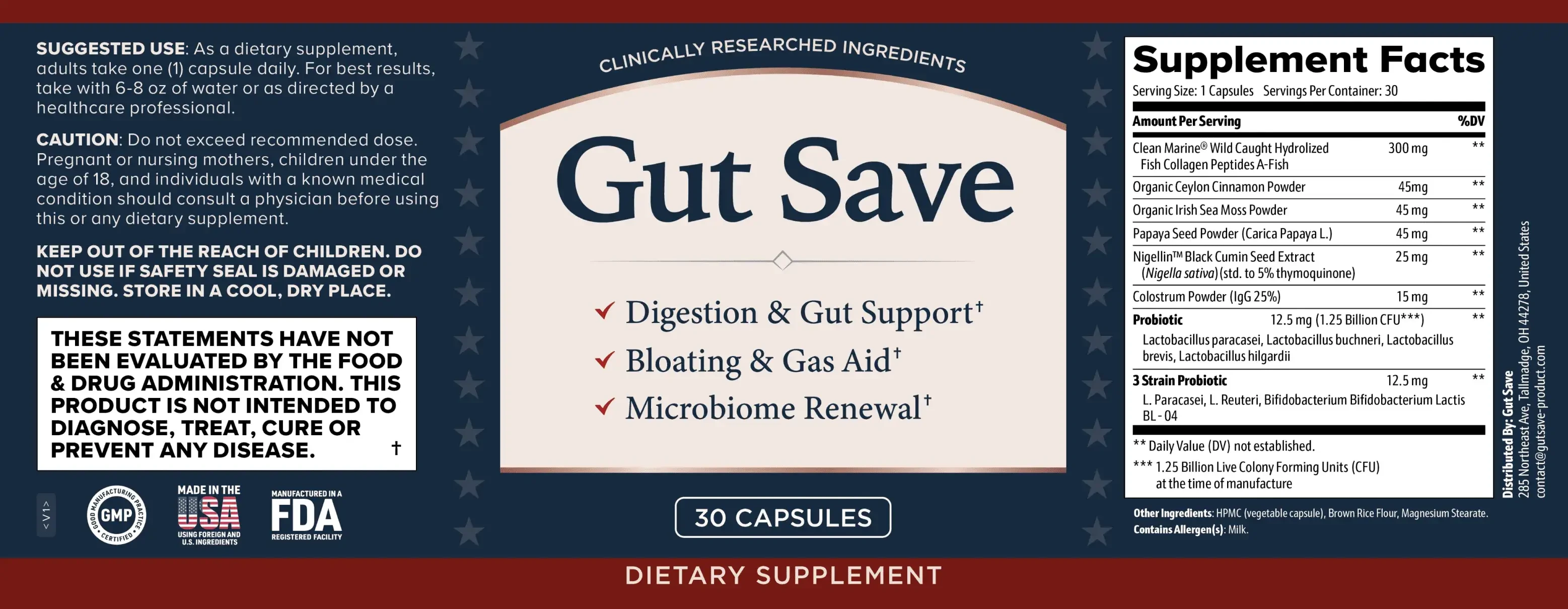
Gut Save's Supplement Facts panel - every ingredient dose is disclosed (though one probiotic blend's CFU is not stated).
Clean Marine Fish Collagen Peptides – 300 mg
At 300 mg this is nearly two-thirds of the capsule by weight, and it's the ingredient with the flashiest name ("Clean Marine" is a branded collagen). Collagen peptides are basically pre-digested protein, rich in glycine, proline and hydroxyproline. There's a lot of internet enthusiasm for collagen "sealing" the gut lining, and a handful of animal and cell studies, but we couldn't find convincing human trials showing oral collagen at anything like this dose repairs the intestinal wall. A typical collagen supplement dose for skin or joints is 5 to 10 grams. 300 mg is a rounding error against that. What it does do is add a small amount of amino acids your body can use, and give the formula a big number to put on the front of the label. Allergen note: it's fish.
Probiotic Blend (1.25 Billion CFU) – 12.5 mg
This is the ingredient that decides whether Gut Save is a serious gut product or a gentle one, and the answer is gentle. Four strains: Lactobacillus paracasei, L. buchneri, L. brevis and L. hilgardii, totalling 1.25 billion colony-forming units. Probiotics are among the better-evidenced things you can take for bloating; a 2025 meta-analysis in IBS patients found meaningful benefits, though effects varied a lot by strain. The problem is dose. The trials that showed benefit mostly used somewhere between 10 and 50 billion CFU a day, sometimes more. Gut Save gives you about a tenth of the bottom of that range. Two of the four strains (buchneri and hilgardii) are also better known from silage and wine fermentation than from human gut research. Real bacteria, sensible idea, not enough of them.
3-Strain Probiotic – 12.5 mg
The strain selection here is actually stronger than in the first blend. Bifidobacterium lactis BL-04 has been used in several human trials, and L. reuteri is one of the most-studied probiotic species there is. So we were pleased to see them. Then we looked for the CFU count and there isn't one. The label gives 12.5 mg by weight, which tells you nothing about how many live organisms you're getting; 12.5 mg of a freeze-dried culture could be anywhere from a few million to a few billion. On a label that prints every other number, that omission stands out. Our guess is it's small, but it's only a guess.
Colostrum Powder (IgG 25%) – 15 mg
Colostrum is the first milk a cow produces after calving, and it's dense with antibodies (IgG), growth factors and lactoferrin. There's a real and rather elegant study from 2011 in which athletes who took bovine colostrum had a much smaller increase in gut permeability after hard exercise than those on placebo. That's the "gut barrier" research the marketing leans on. The athletes took 20 grams a day. Gut Save contains 15 milligrams, which is more than a thousand times less. At that dose the colostrum is a nod to the science rather than an attempt to reproduce it. It's also a dairy product, so anyone with a milk allergy is out.
Nigellin Black Cumin Seed Extract – 25 mg
Nigella sativa seeds have been used for stomach complaints across the Middle East and South Asia for a very long time, and unlike some traditional remedies this one has held up reasonably well under modern testing. Thymoquinone, the active compound Gut Save standardises to, has anti-inflammatory effects in the lab and there are small human trials in functional dyspepsia and H. pylori. The catch, as with most of this formula, is quantity: those trials tended to use 1 to 2 grams of seed or oil, and Gut Save has 25 mg of a 5% extract. Still, of all the herbs in here it's the one with the best case for inclusion.
Organic Ceylon Cinnamon Powder – 45 mg
Two things to say. First, the choice of Ceylon over cassia is a good one. Cassia, the cheap cinnamon in most supermarket jars, contains coumarin, which is hard on the liver in regular high doses. Ceylon has almost none. Somebody paid attention. Second, 45 mg is roughly a fifth of a teaspoon. The blood-sugar research on cinnamon used 1 to 6 grams a day. So this is a pleasant, harmless addition that adds some polyphenols and not much else. If you're on diabetes medication it's still worth mentioning to your pharmacist, but at this level we wouldn't expect much effect either way.
Organic Irish Sea Moss Powder – 45 mg
Irish moss has had a remarkable few years thanks to social media, and most of what's claimed for it online is either unproven or refers to the seaweed in general rather than any human trial. It is a genuine source of soluble fibre (carrageenan and related polysaccharides) and minerals, and fibre feeds gut bacteria, so the prebiotic label isn't absurd. But 45 mg of sea moss is a trivial amount of fibre; a single apple has around 4,000 mg. The thing that actually matters about this ingredient is iodine. Seaweed concentrates it, and while the amount in 45 mg is probably modest, the label doesn't say how much. If you have any thyroid condition, or take levothyroxine, this is the one to ask your doctor about.
Papaya Seed Powder – 45 mg
Papaya is a classic post-meal digestive, partly because the fruit contains papain, an enzyme that breaks down protein. The evidence most often cited is a 2013 study by Muss and colleagues in which a standardised papaya preparation (Caricol) improved constipation and bloating compared with placebo over 40 days. That's a decent result. But Caricol is a concentrated fruit preparation taken in 20 ml sachets; Gut Save uses 45 mg of seed powder, which is a different part of the plant at a very different dose. So the study supports the idea, not the specific ingredient. We'd still put papaya in the "reasonable" column.
The Overall Verdict on Gut Save's Formula
Transparent and broad, but modest and mixed
Put the whole label together and the picture is consistent: sensible ingredient choices, honest labelling, and doses that sit well below what the research used, in most cases by an order of magnitude or more. The probiotics have the best evidence and the worst dose problem. Papaya and black cumin are defensible. Colostrum is a token amount. Collagen and sea moss are mostly there for the label.
None of this makes Gut Save a bad product. It makes it a mild one. If you want a single daily capsule that touches several bases lightly, and you like being able to read exactly what's in it, that's what you're getting. If you're expecting any one ingredient to do serious work at these amounts, you'll be disappointed. Read our full Gut Save review for the pricing and refund side.
Allergens and interactions: fish (from the collagen) and milk (from the colostrum) are both in every capsule. The sea moss contains iodine, which matters if you have a thyroid condition or take thyroid medication. Check with your doctor if either applies to you.